
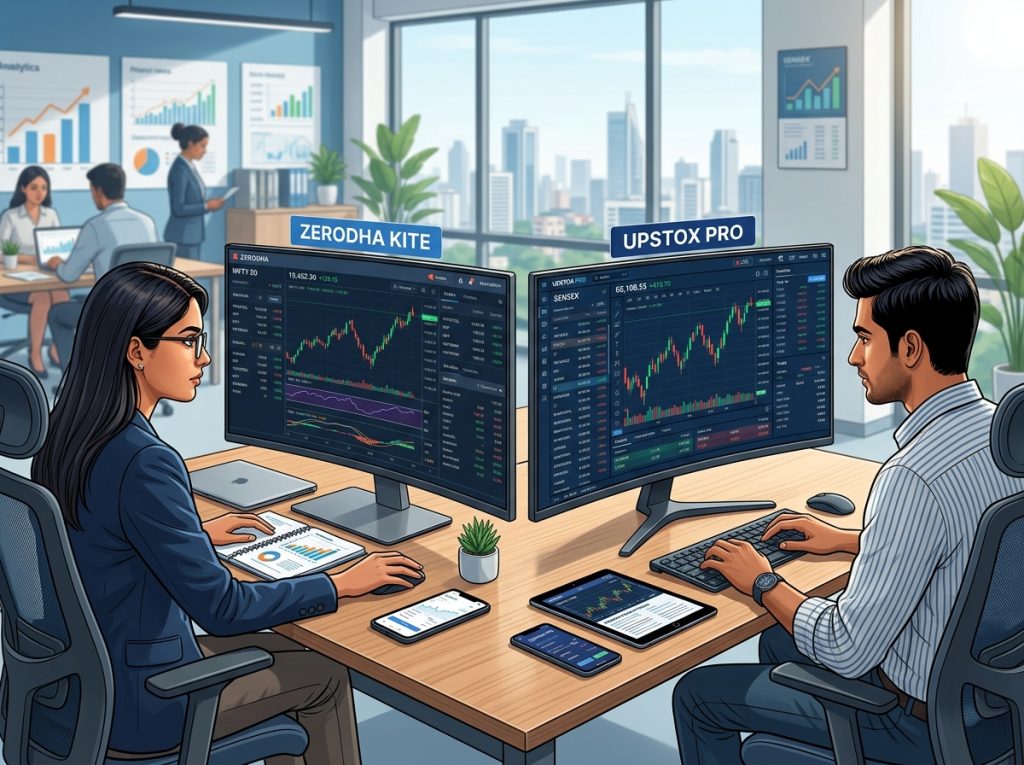
The Indian stock market has become more accessible than ever before. Over the last decade, discount brokers have transformed investing by reducing costs, simplifying account opening, and offering powerful trading tools through web and mobile platforms.
Among all discount brokers operating in India, two names consistently dominate discussions: Zerodha and Upstox.
Whether you’re opening your first Demat account, actively trading stocks, investing in mutual funds, or exploring futures and options, you’ve likely encountered the question:
Zerodha vs Upstox—which one should you choose?
The answer isn’t always straightforward. Both brokers offer competitive pricing, modern trading platforms, and access to Indian financial markets. However, they differ in several important areas, including platform design, research tools, ecosystem strength, customer experience, educational resources, and overall suitability for different types of investors.
At Retro Living Today, we believe investors should evaluate brokers based on their individual goals rather than marketing claims. A long-term investor may prioritize reliability and investment tools, while an active trader may focus on execution speed, charting features, and margin facilities.
This comprehensive Zerodha vs Upstox comparison examines both platforms from multiple angles, helping you understand where each broker excels and where limitations exist. By the end of this guide, you’ll have a clear understanding of which broker aligns best with your investing and trading style.
Zerodha Overview
Founded in 2010, Zerodha is widely recognized as India’s pioneer discount broker. It disrupted the traditional brokerage industry by introducing flat-fee trading and significantly reducing costs for retail investors.
Over the years, Zerodha has grown into one of India’s largest brokerage firms, serving millions of investors and traders across the country.
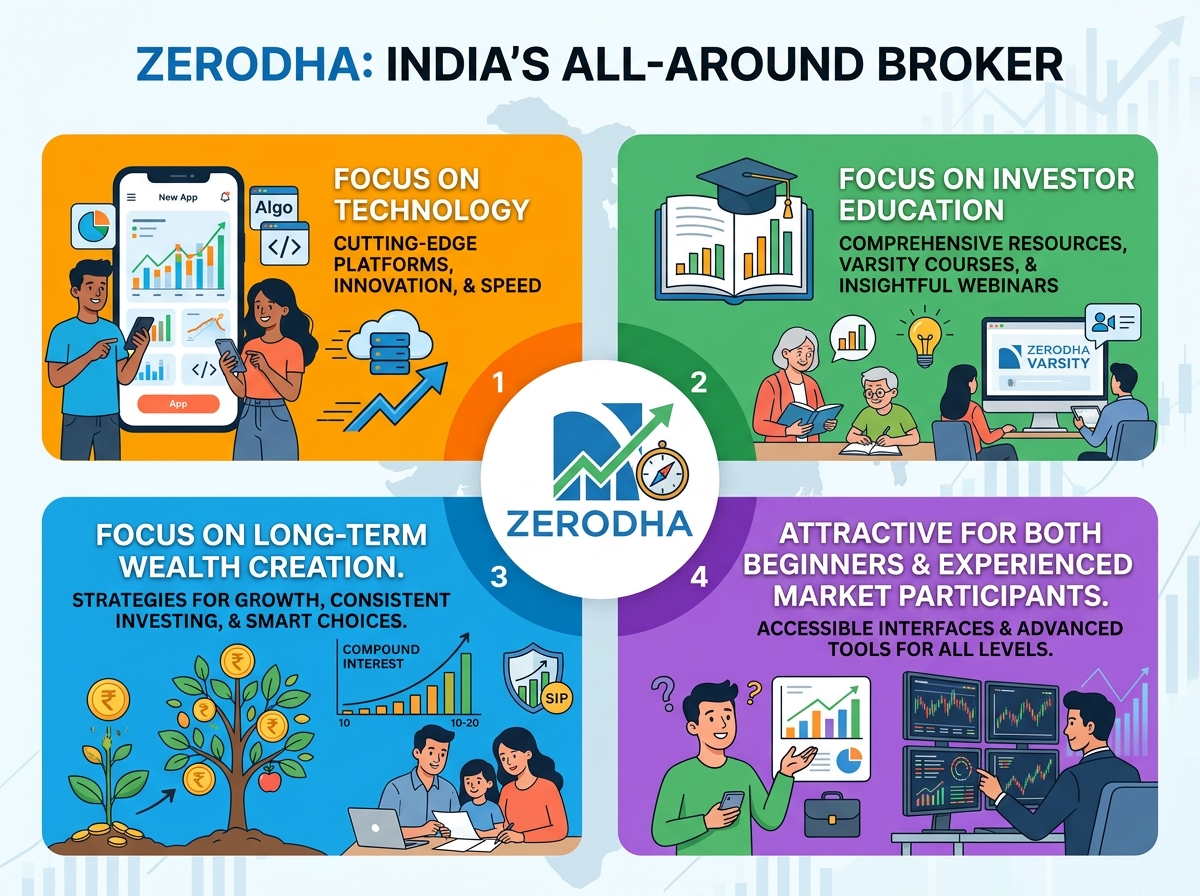
What makes Zerodha particularly notable is its ecosystem-driven approach. Instead of focusing solely on trading, the company has built a comprehensive suite of tools that support investing, portfolio management, learning, and market analysis.
Key Features of Zerodha
- Flat brokerage structure
- Direct mutual fund investing through Coin
- Advanced trading platform (Kite)
- Portfolio analytics through Console
- Educational platform Varsity
- Trading APIs for developers
- Large user community
- Extensive market coverage
Best Use Cases
Zerodha is particularly suitable for:
- Long-term investors
- Beginners learning the stock market
- Mutual fund investors
- Swing traders
- Technical traders
- Advanced traders requiring APIs
Advantages
- Industry-leading educational resources
- Strong reputation and trust factor
- Mature technology ecosystem
- Powerful charting tools
- Direct mutual fund investing
- Transparent pricing structure
Limitations
- No physical branches for extensive support
- Certain advanced features require a learning curve
- Margin offerings may not appeal to aggressive traders
Who It Is Best For
Investors seeking a stable, feature-rich ecosystem with strong educational support often find Zerodha an excellent long-term choice.
Upstox Overview
Upstox has emerged as one of India’s fastest-growing discount brokers. Originally launched as RKSV Securities, the company rebranded to Upstox and expanded aggressively through technology-focused solutions and competitive pricing.
Today, Upstox serves millions of investors and traders and is frequently mentioned alongside Zerodha when discussing leading discount brokers in India.
One of Upstox’s major strengths is accessibility. The platform aims to simplify trading for beginners while still offering tools that appeal to active traders.
The company has invested heavily in user experience, mobile-first design, and platform modernization, making it increasingly attractive to younger investors entering the market.
Key Features of Upstox
- Flat brokerage pricing
- User-friendly trading platform
- Modern mobile trading app
- Fast account opening process
- Advanced charting tools
- Market analysis features
- Multiple asset classes
- Growing educational content
Best Use Cases
Upstox works particularly well for:
- New investors
- Mobile-first traders
- Active traders
- Options traders
- Intraday traders
- Cost-conscious investors
Advantages
- Easy-to-use interface
- Competitive pricing
- Modern platform design
- Strong mobile experience
- Quick onboarding process
- Frequent platform updates
Limitations
- Smaller ecosystem compared to Zerodha
- Educational resources not as extensive
- Some investors prefer Zerodha’s established reputation
Who It Is Best For
Investors looking for a simple, modern, and efficient trading experience often find Upstox appealing, particularly when mobile trading is a priority.
Verdict
Upstox has successfully positioned itself as a strong competitor to Zerodha. Its focus on usability and platform innovation makes it one of the most attractive discount brokers currently available in India.

Zerodha vs Upstox: Quick Comparison Table
| Feature | Zerodha | Upstox |
|---|---|---|
| Founded | 2010 | 2009 (RKSV) |
| Broker Type | Discount Broker | Discount Broker |
| Equity Delivery | Free | Free |
| Intraday Brokerage | Flat Fee | Flat Fee |
| Trading Platform | Kite | Upstox Pro |
| Direct Mutual Funds | Yes | Yes |
| Educational Resources | Extensive | Growing |
| API Access | Yes | Yes |
| Mobile Trading | Excellent | Excellent |
| Beginner Friendly | Very Good | Very Good |
While the table provides a quick snapshot, choosing a broker requires a deeper understanding of how each platform performs in real-world situations.
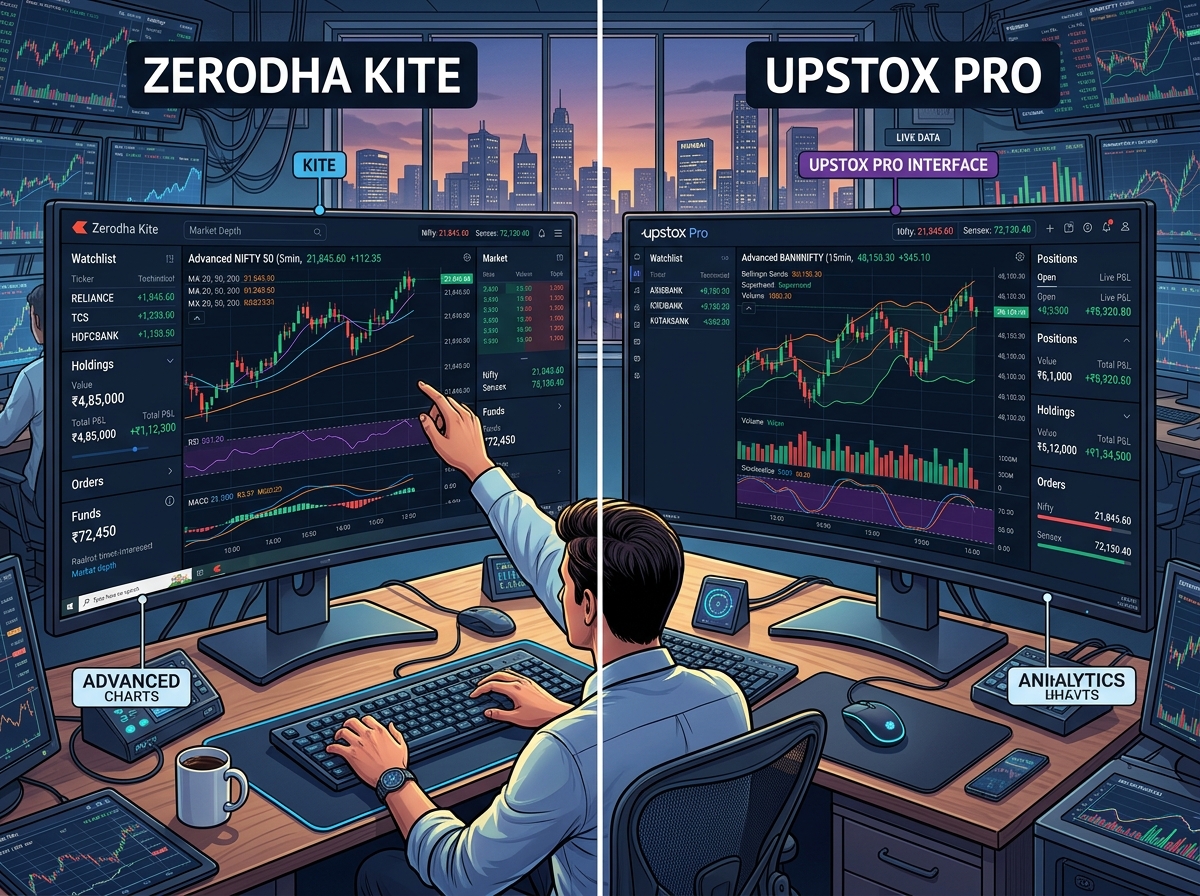
Trading Platform Comparison: Kite vs Upstox Pro
The trading platform is arguably the most important component of any broker relationship.
Investors may occasionally log in to check portfolios, but active traders interact with their trading platforms daily. Performance, usability, reliability, and available tools significantly influence the trading experience.
Zerodha Kite
Kite is often regarded as one of India’s most polished trading platforms.
The platform offers:
- Clean interface
- Fast order execution
- Multi-device support
- Advanced charting
- Hundreds of technical indicators
- Market depth analysis
- Watchlists and alerts
One of Kite’s strengths is its balance between simplicity and sophistication. Beginners can start quickly, while advanced traders gain access to powerful analytical tools.
Another major advantage is integration with Zerodha’s broader ecosystem, including Console, Coin, and Varsity.
Upstox Pro
Upstox Pro has evolved significantly over the years.
The platform focuses on:
- Simplicity
- Speed
- Modern design
- Mobile-first experience
- Technical analysis tools
- Real-time market tracking
Many traders appreciate Upstox Pro’s intuitive interface, especially those transitioning from beginner-level trading platforms.
The mobile app experience is particularly strong and continues to improve with regular updates.
Trading Experience Verdict
For pure trading functionality, both platforms perform exceptionally well.
However:
Choose Zerodha Kite if:
- You want ecosystem integration
- You value advanced analytics
- You use multiple investment products
- You appreciate educational tools
Choose Upstox Pro if:
- You prioritize simplicity
- You trade primarily through mobile devices
- You want a modern interface
- You prefer a streamlined experience
Account Opening and Onboarding Experience
For first-time investors, the account opening process often influences their initial impression of a broker.
Today’s investors expect:
- Paperless onboarding
- Fast verification
- Easy KYC completion
- Quick activation
Fortunately, both Zerodha and Upstox have streamlined their onboarding systems.
Zerodha Account Opening
Zerodha offers a largely digital process.
Typical requirements include:
- PAN card
- Aadhaar card
- Bank account details
- Income proof for derivatives trading
The process is straightforward and generally completed online.
What differentiates Zerodha is the extensive guidance available throughout the onboarding journey. New investors can access educational content almost immediately after opening an account.
Upstox Account Opening
Upstox emphasizes speed and convenience.
Its onboarding experience is designed for users who prefer minimal friction.
The account opening process includes:
- Online KYC verification
- Digital documentation
- Quick identity checks
- Mobile-friendly workflow
Many users report a smooth and efficient registration experience.
Which Broker Is Better for Beginners?
For complete beginners, the difference isn’t necessarily the account opening process itself.
The real distinction emerges after onboarding.
Zerodha’s extensive learning ecosystem helps new investors understand markets, products, and risk management.
Upstox provides a simpler path into trading but currently offers a less comprehensive educational environment.
Therefore:
- Best for investor education: Zerodha
- Best for quick onboarding: Upstox

Why This Comparison Matters in 2026
The brokerage industry continues evolving rapidly.
Investors today expect much more than low brokerage fees. They want:
- Reliable technology
- Educational support
- Portfolio analytics
- Mobile accessibility
- Research tools
- Fast execution
- Transparent pricing
Both Zerodha and Upstox have adapted to these expectations, but their approaches differ.
Understanding those differences can help investors avoid switching brokers later and ensure they select a platform aligned with their long-term financial goals.
In the next section, we’ll dive deeper into one of the most important decision-making factors for investors and traders: brokerage charges, account fees, hidden costs, margin facilities, and overall pricing value.
Brokerage Charges and Pricing Comparison
When investors search for terms like “zerodha vs upstox charges,” “which is cheaper zerodha or upstox,” or “upstox vs zerodha brokerage comparison,” they are usually trying to determine the true cost of investing and trading.
While both brokers operate under the discount brokerage model, understanding the complete fee structure is essential before opening an account.
A broker with lower visible charges may still involve other fees that affect overall trading profitability.
Zerodha Pricing Structure
Zerodha follows a straightforward pricing model:
- Equity delivery investments: No brokerage
- Intraday trades: Flat fee per executed order
- Futures trading: Flat fee per executed order
- Options trading: Flat fee per executed order
- Direct mutual funds: No commission
- Additional statutory charges apply
The simplicity of Zerodha’s pricing model is one reason it became popular among retail investors.
Long-term investors particularly appreciate the absence of brokerage charges on equity delivery investments.
Upstox Pricing Structure
Upstox also follows a discount brokerage model similar to Zerodha.
Key pricing highlights include:
- Free equity delivery investing
- Flat-fee intraday trading
- Competitive F&O pricing
- Direct investment products
- Transparent fee disclosures
For most retail investors, the brokerage differences between Zerodha and Upstox are relatively small.
The decision often comes down to platform preference rather than pricing alone.
Hidden Charges: What Investors Should Know
Many beginners focus exclusively on brokerage fees and ignore other market-related expenses.
Regardless of whether you choose Zerodha or Upstox, you may encounter:
- Securities Transaction Tax (STT)
- Exchange transaction charges
- SEBI turnover fees
- Stamp duty
- GST
- Depository Participant charges
These costs are regulated and generally not controlled by the broker.
Pricing Verdict
For most investors:
- Zerodha = Excellent pricing transparency
- Upstox = Highly competitive fee structure
Neither broker holds a significant advantage purely on brokerage charges.
Instead, investors should evaluate the total value received through technology, research tools, support, and platform quality.
Investment Products and Market Access
A broker should support your future investing needs—not just your current requirements.
Many investors start with stocks and later expand into:
- Mutual funds
- ETFs
- Futures
- Options
- Bonds
- IPOs
- Government securities
Choosing a broker that supports long-term growth can save significant effort later.
Zerodha Investment Options
Zerodha provides access to:
Stocks
Invest in listed Indian companies through NSE and BSE.
Mutual Funds
The Coin platform allows direct mutual fund investments without distributor commissions.
ETFs
Exchange-traded funds across various sectors and indices.
IPO Investments
Apply for public offerings directly through supported systems.
Bonds and Government Securities
Fixed-income options for conservative investors.
Futures and Options
Advanced trading products for experienced traders.
Upstox Investment Options
Upstox offers a similarly broad product range.
Stocks
Invest in Indian equities through major exchanges.
Mutual Funds
Direct mutual fund investing through its investment platform.
ETFs
Diversification through exchange-traded funds.
IPO Applications
Convenient access to public offerings.
Derivatives
Futures and options trading support.
Additional Investment Products
Growing ecosystem aimed at modern investors.
Investment Flexibility Verdict
Both brokers cover the needs of most retail investors.
However, Zerodha’s investment ecosystem feels slightly more mature due to the integration of various investment tools and portfolio management resources.
Research Tools and Market Analysis Features
One of the biggest differences between casual investors and successful investors is the quality of research used before making decisions.
Many beginners underestimate how valuable research platforms can become over time.
Zerodha Research Ecosystem
Zerodha has invested heavily in investor education and analysis tools.
Important components include:
Varsity
One of the most respected stock market education platforms in India.
Topics include:
- Fundamental analysis
- Technical analysis
- Futures and options
- Risk management
- Portfolio construction
- Behavioral finance
Console
Provides advanced portfolio insights including:
- Performance tracking
- Profit and loss analysis
- Tax reporting
- Investment history
Kite Analytics
Supports technical traders through charting and indicators.
Upstox Research Tools
Upstox has significantly improved its research capabilities.
Features include:
- Market insights
- Technical analysis tools
- Trading screeners
- Watchlists
- Educational resources
- Market news integration
The platform continues to evolve and attract active traders.
Research Verdict
For education and long-term investor development:
Winner: Zerodha
For practical day-to-day trading tools:
Tie between Zerodha and Upstox
Mobile Trading Experience
Mobile investing has become the preferred choice for millions of investors.
A strong mobile app is no longer optional.
It’s essential.
Zerodha Mobile App
The Kite mobile application offers:
- Clean interface
- Fast performance
- Advanced charting
- Order management
- Portfolio monitoring
- Watchlists
- Alerts
Despite its power, the app remains beginner-friendly.
Upstox Mobile App
Upstox has built its reputation partly through mobile-first investing.
Highlights include:
- Intuitive navigation
- Modern design
- Quick trade execution
- Technical indicators
- Real-time market updates
- Portfolio tracking
Many younger investors appreciate its simplified design.
Mobile Trading Verdict
Choose Zerodha if:
- You want deeper ecosystem integration.
- You use advanced analytics.
- You actively manage multiple investments.
Choose Upstox if:
- Mobile trading is your primary activity.
- You prefer a simpler interface.
- You want a highly modern user experience.
Customer Support Comparison
Customer support often becomes important only when something goes wrong.
Issues can include:
- Account verification problems
- Fund transfers
- Corporate actions
- Technical platform issues
- Trading-related queries
The quality of support can significantly affect the investor experience.
Zerodha Customer Support
Zerodha offers:
- Support tickets
- Help center resources
- Educational guides
- Community discussions
- Knowledge base articles
Strengths:
- Extensive self-help resources
- Strong documentation
- Detailed FAQs
Limitations:
- High customer volumes occasionally affect response times
Upstox Customer Support
Upstox provides:
- Ticket support
- Help center
- Customer assistance channels
- Educational support materials
Strengths:
- User-friendly support resources
- Growing support infrastructure
Limitations:
- Experience may vary depending on issue complexity
Customer Support Verdict
Investors who prefer self-service learning often favor Zerodha.
Investors seeking a streamlined support experience may find Upstox equally suitable.
Zerodha Pros and Cons
Advantages
Strong Brand Reputation
Zerodha is often viewed as one of India’s most trusted discount brokers.
Exceptional Learning Resources
Varsity remains a major competitive advantage.
Mature Ecosystem
The combination of Kite, Coin, Console, and APIs creates a complete investing environment.
Reliable Technology
The platform has been refined through years of user feedback.
Long-Term Investing Focus
Excellent for investors building wealth gradually.
Limitations
Learning Curve
The ecosystem can initially feel overwhelming.
Limited Hand-Holding
Some beginners may prefer more guided onboarding.
Not Built Exclusively for Mobile Users
Although excellent, the experience is more ecosystem-focused than mobile-first.
Best For
- Long-term investors
- Serious learners
- Portfolio builders
- Mutual fund investors
- Hybrid investors and traders
Verdict
Zerodha remains one of the strongest choices for investors seeking an all-in-one investing ecosystem.
Upstox Pros and Cons
Advantages
Modern User Interface
Simple and accessible for new investors.
Strong Mobile Experience
Designed with mobile users in mind.
Competitive Pricing
Maintains parity with leading discount brokers.
Fast Onboarding
Simple account opening process.
Continuous Innovation
Regular platform improvements and feature updates.
Limitations
Smaller Educational Ecosystem
Still developing compared to Zerodha’s extensive learning resources.
Fewer Integrated Tools
The ecosystem is not yet as comprehensive.
Lower Educational Depth
Advanced investors may seek additional external resources.
Best For
- Mobile traders
- New investors
- Active traders
- Younger investors
- Simplicity-focused users
Verdict
Upstox delivers a highly competitive and modern trading experience that continues to improve year after year.
Risk Considerations for New Investors
Before choosing any broker, investors should understand that:
- A broker cannot guarantee profits.
- Lower brokerage does not eliminate market risk.
- Trading frequently does not necessarily improve returns.
- Derivatives involve substantial risk.
- Research and diversification remain essential.
Whether you choose Zerodha or Upstox, successful investing depends more on strategy, discipline, and education than on brokerage selection alone.
Beginner Guidance
If you’re opening your first Demat account:
- Learn basic investing concepts.
- Avoid excessive trading.
- Focus on long-term investing initially.
- Understand risk management.
- Diversify investments.
- Continue financial education.
Many investors spend weeks comparing brokers but very little time learning investing fundamentals. The opposite approach often leads to better long-term outcomes.
Zerodha vs Upstox for Beginners
One of the most searched questions online is:
“Should beginners use Zerodha or Upstox?”
The answer depends on what kind of beginner you are.
If your goal is simply opening a Demat account and buying your first stocks, both platforms are suitable. Their account opening processes are digital, user interfaces are relatively easy to understand, and pricing structures are transparent.
However, investing successfully requires more than placing buy and sell orders.
New investors often need help understanding:
- Fundamental analysis
- Technical analysis
- Asset allocation
- Risk management
- Diversification
- Tax implications
- Market psychology
This is where Zerodha has a meaningful advantage.
Its educational ecosystem allows investors to continue learning as their knowledge grows.
Why Beginners May Prefer Zerodha
- Comprehensive educational resources
- Structured learning through Varsity
- Strong investing ecosystem
- Long-term wealth-building focus
- Excellent portfolio analytics
Why Beginners May Prefer Upstox
- Simpler interface
- Quick onboarding
- Easy navigation
- Mobile-first experience
- Less intimidating platform design
Beginner Verdict
Winner: Zerodha
While Upstox offers an excellent user experience, Zerodha provides a stronger foundation for long-term investor education.
Zerodha vs Upstox for Intraday Trading
Active traders evaluate brokers differently than investors.
For intraday traders, key factors include:
- Order execution
- Platform stability
- Charting capabilities
- Speed
- Technical indicators
- Market depth visibility
- Trading workflow
Zerodha for Intraday Trading
Strengths include:
- Advanced charting
- Stable trading environment
- Deep analytical tools
- Multiple order types
- Strong ecosystem integration
Potential limitations:
- Slightly more feature-heavy for beginners
Upstox for Intraday Trading
Strengths include:
- Fast execution experience
- Clean interface
- Mobile trading convenience
- Responsive platform design
Potential limitations:
- Fewer integrated analytical tools compared with Zerodha’s broader ecosystem
Intraday Trading Verdict
For advanced traders:
Winner: Zerodha
For simplicity-focused active traders:
Winner: Upstox
Overall edge:
Zerodha
Zerodha vs Upstox for Options Trading
Options trading continues to grow rapidly in India.
Many traders searching for:
- “zerodha vs upstox for options trading”
- “best broker for options trading”
- “which broker is better for F&O”
are looking for the most efficient trading environment.
Zerodha Options Trading Experience
Advantages:
- Advanced charting
- Reliable execution
- Strong analytics
- Educational derivatives content
- Robust trading infrastructure
Upstox Options Trading Experience
Advantages:
- User-friendly interface
- Mobile accessibility
- Fast order placement
- Growing feature set
Options Trading Verdict
Serious options traders often benefit from Zerodha’s extensive ecosystem and educational resources.
Winner: Zerodha
Zerodha vs Upstox for Long-Term Investing
Long-term investors have very different priorities than active traders.
They care about:
- Reliability
- Portfolio tracking
- Research tools
- Mutual funds
- SIP investing
- Tax reporting
- Wealth creation support
Why Long-Term Investors Prefer Zerodha
The platform’s ecosystem is particularly attractive to investors who:
- Build diversified portfolios
- Invest regularly
- Track performance carefully
- Use direct mutual funds
- Value educational content
Console and Coin provide meaningful advantages for long-term investors.
Why Long-Term Investors May Choose Upstox
Upstox still offers:
- Direct investing
- Mutual fund access
- Portfolio tracking
- Mobile convenience
However, the overall ecosystem is less comprehensive.
Long-Term Investing Verdict
Winner: Zerodha
The broader investment-focused ecosystem gives Zerodha a clear advantage for long-term wealth builders.
Feature-by-Feature Comparison
| Category | Zerodha | Upstox | Winner |
|---|---|---|---|
| Brand Reputation | Excellent | Very Good | Zerodha |
| Educational Resources | Excellent | Good | Zerodha |
| Mobile Experience | Excellent | Excellent | Tie |
| Trading Platform | Excellent | Excellent | Tie |
| Long-Term Investing | Excellent | Very Good | Zerodha |
| Mutual Fund Investing | Excellent | Very Good | Zerodha |
| Beginner Education | Excellent | Good | Zerodha |
| Active Trading | Excellent | Excellent | Tie |
| Options Trading | Excellent | Very Good | Zerodha |
| User Interface Simplicity | Very Good | Excellent | Upstox |
| Ecosystem Depth | Excellent | Good | Zerodha |
| Portfolio Analytics | Excellent | Very Good | Zerodha |
| Mobile-First Design | Very Good | Excellent | Upstox |
| Overall Value | Excellent | Excellent | Zerodha |
Final Verdict: Which Broker Should You Choose?
Choosing between Zerodha and Upstox is not about finding a bad option and a good option.
Both are among India’s leading discount brokers.
The better question is:
Which broker aligns with your investing style?
Choose Zerodha If:
You want:
- The most complete investing ecosystem
- Strong educational resources
- Portfolio analytics
- Direct mutual fund investing
- Advanced trading tools
- Long-term investing support
- Extensive learning opportunities
Choose Upstox If:
You want:
- A highly modern interface
- Mobile-first investing
- Fast onboarding
- Simplicity
- Active trading convenience
- Easy navigation
Overall Winner
For most investors and traders in 2026:
🏆 Zerodha wins by a small but meaningful margin.
The combination of education, ecosystem depth, investment tools, analytics, and long-term investor support gives it a slight advantage over Upstox.
That said, Upstox remains one of the strongest alternatives available and may be the better choice for investors who prioritize simplicity and mobile usability.
Suggested External References
For authority and EEAT signals, reference:
- Zerodha Official Website
- Upstox Official Website
- SEBI (Securities and Exchange Board of India)
- NSE India
- BSE India
- CDSL India
- NSDL India
Frequently Asked Questions (FAQs)
Which is better, Zerodha or Upstox in 2026?
Both brokers are excellent choices. Zerodha generally offers a stronger ecosystem, educational resources, and portfolio analytics, while Upstox excels in mobile usability and interface simplicity.
Is Upstox cheaper than Zerodha?
In most common trading scenarios, both brokers have very similar pricing structures. Investors should compare the latest fee schedules and account charges before opening an account.
Which broker is better for beginners: Zerodha or Upstox?
Beginners focused on learning investing fundamentals often benefit more from Zerodha’s educational resources. Those seeking a simpler mobile-first experience may prefer Upstox.
Is Zerodha safer than Upstox?
Both operate under Indian regulatory requirements and provide access to regulated market infrastructure. Investors should always verify current regulatory status and account protections before investing.
Which broker is best for intraday trading?
Both support active trading effectively. Zerodha offers a deeper analytical ecosystem, while Upstox provides a streamlined trading experience.
Which platform has better charting tools?
Both platforms offer advanced charting capabilities. Zerodha’s broader ecosystem and analytical integrations provide additional advantages for technical traders.
Can I invest in mutual funds through Zerodha and Upstox?
Yes. Both brokers allow investors to access mutual fund investments, including direct investment options.
Which broker is better for options trading?
Many experienced options traders prefer Zerodha due to its educational resources, analytics, and broader ecosystem. Upstox remains a strong alternative.
Should long-term investors choose Zerodha or Upstox?
Long-term investors often find Zerodha more attractive because of Coin, Console, educational resources, and portfolio management capabilities.
Can I switch brokers later?
Yes. Investors can transfer holdings through the applicable transfer process if they decide another broker better suits their needs.
Finance Disclaimer
This article is intended for educational and informational purposes only and should not be considered financial, investment, tax, or legal advice. Brokerage features, fees, regulations, and services may change over time. Always verify the latest information from official broker websites and consult a qualified financial advisor before making investment decisions.
Conclusion
The Zerodha vs Upstox comparison ultimately comes down to your investing priorities.
Both platforms have transformed stock market participation in India by making investing more accessible, affordable, and technology-driven. They offer competitive pricing, modern trading tools, and broad market access, making either broker a viable choice for retail investors.
However, after evaluating platform capabilities, educational resources, portfolio analytics, investment tools, trading experience, and ecosystem depth, Zerodha maintains a slight overall advantage. Its focus on investor education, long-term wealth building, and integrated financial tools creates a comprehensive experience that appeals to both beginners and experienced market participants.
Upstox remains an outstanding alternative, especially for investors who value a clean user interface, mobile-first functionality, and a streamlined trading experience.
At Retro Living Today, we recommend choosing the broker that best aligns with your goals rather than simply selecting the most popular option. The best broker is the one that helps you stay disciplined, continue learning, and build wealth consistently over time.
For more investing guides, fintech comparisons, and personal finance insights, explore additional content on Retro Living Today and continue building your financial knowledge with confidence.