

For many people, investing feels intimidating. The financial world is filled with unfamiliar terminology, endless opinions, market fluctuations, and conflicting advice. It’s easy to assume that investing is only for wealthy individuals, finance professionals, or people who have years of experience.
The reality is very different. Investing has become more accessible than ever before. Modern brokerage platforms, low-cost index funds, exchange-traded funds (ETFs), and educational resources allow almost anyone to begin building wealth regardless of their starting point.
Understanding investing is no longer optional for people who want to achieve long-term financial security. Inflation gradually reduces the purchasing power of cash, while investments have historically provided opportunities for wealth growth over time. Whether your goal is retirement savings, financial freedom, buying a home, funding education, or building passive income, investing can help you reach those objectives more efficiently than relying solely on traditional savings accounts.
This beginner’s guide to investing from Retro Living Today explains how investing works, the different types of investments available, practical strategies for first-time investors, common mistakes to avoid, and how to create a sustainable long-term investment plan.
What Is Investing?
Investing is the process of allocating money into assets with the expectation that they will increase in value over time or generate income.
Unlike saving, which focuses on preserving money, investing focuses on growing money.
Examples of investments include:
- Stocks
- Bonds
- Mutual funds
- ETFs
- Real estate
- Dividend-paying securities
- Retirement accounts
When you invest, your money works for you. Instead of sitting idle in a bank account, it has the potential to generate returns through appreciation, dividends, interest payments, or other forms of income.
One of the most powerful concepts in investing is compound growth. Earnings generated by investments can be reinvested, creating additional earnings over time. This compounding effect can significantly increase wealth over decades.
Why Investing Matters
Investing can help you:
- Build long-term wealth
- Combat inflation
- Create passive income
- Prepare for retirement
- Achieve financial independence
- Reach major financial goals faster
For beginners, the most important lesson is that investing is generally a long-term activity rather than a get-rich-quick strategy.

How to Start Investing for Beginners
Starting your investment journey does not require large amounts of money.
Step 1: Define Your Financial Goals
Before investing, identify your objectives.
Common goals include:
- Retirement investing
- Wealth building
- Saving for a home
- Education funding
- Creating passive income
- Financial freedom
Your goals will influence your investment strategy, risk tolerance, and asset allocation.
Step 2: Build an Emergency Fund
Before investing aggressively, establish an emergency fund covering three to six months of living expenses.
This helps prevent the need to sell investments during market downturns.
Step 3: Understand Risk Tolerance
Risk tolerance refers to your ability and willingness to withstand investment losses.
Factors affecting risk tolerance include:
- Age
- Income stability
- Investment timeline
- Financial obligations
- Personal comfort with market volatility
Younger investors often have longer time horizons and may tolerate higher risk, while those nearing retirement typically focus more on capital preservation.
Step 4: Open an Investment Account
Most beginners start with:
- Brokerage accounts
- Retirement accounts
- Robo-advisors
- Employer-sponsored retirement plans
Choose a platform with low fees, educational resources, and diversified investment options.
Step 5: Start Small
Many investors delay because they think they need thousands of dollars.
In reality, many platforms allow investments starting with small amounts.
Consistency often matters more than the initial investment size.

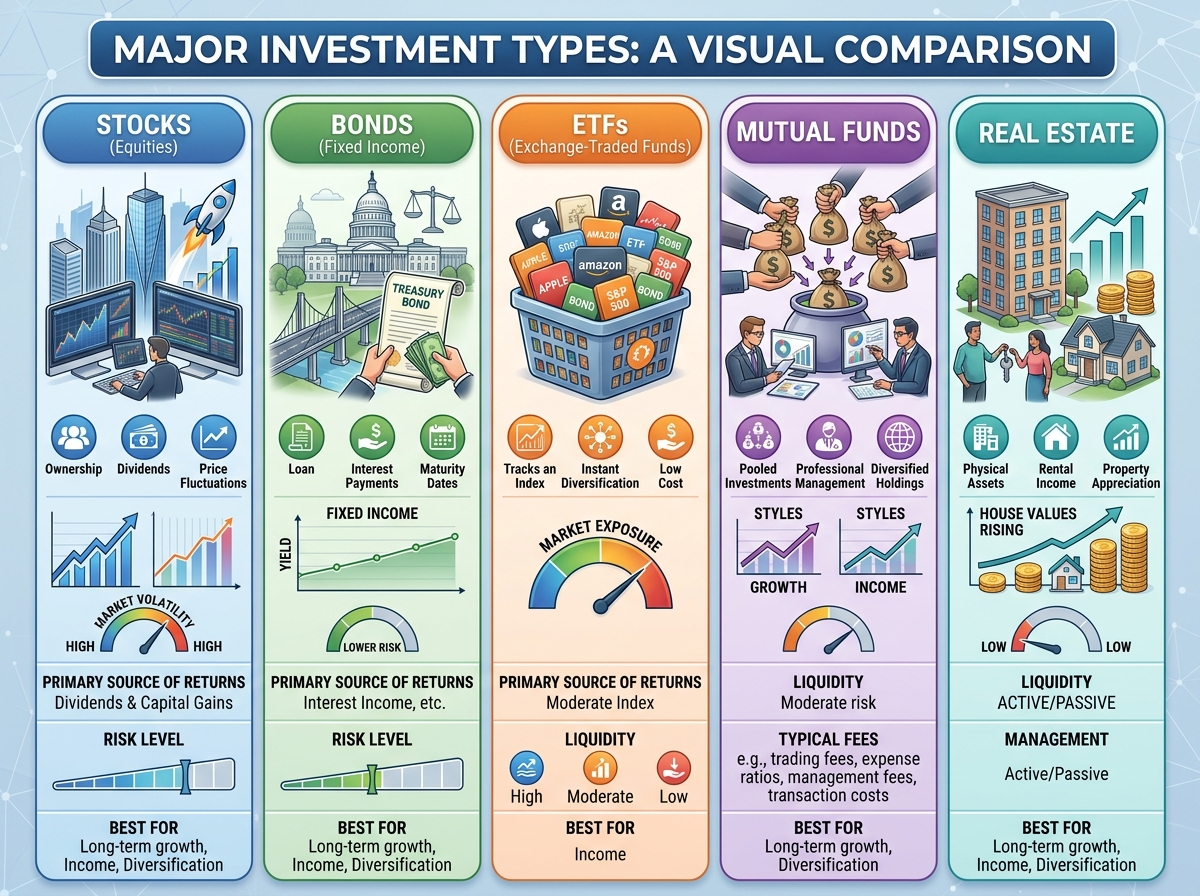
Understanding Different Types of Investments
A key part of investing basics for beginners is understanding available asset classes.
Stocks
Stocks represent ownership in a company.
Benefits:
- Potential for high long-term growth
- Dividend income opportunities
- Liquidity
Risks:
- Market volatility
- Company-specific risk
Stocks are often considered essential components of long-term investment portfolios.
Bonds
Bonds are loans made to governments or corporations.
Benefits:
- Regular interest payments
- Lower volatility than stocks
- Income generation
Risks:
- Interest rate sensitivity
- Inflation risk
ETFs (Exchange-Traded Funds)
ETF investing for beginners is popular because ETFs provide diversification in a single investment.
Benefits:
- Low fees
- Broad diversification
- Easy trading
Examples include:
- Broad market ETFs
- Sector ETFs
- International ETFs
Mutual Funds
Mutual funds pool money from many investors.
Benefits:
- Professional management
- Diversification
- Accessibility
Potential drawbacks include higher fees compared to some ETFs.
Real Estate
Real estate can provide:
- Rental income
- Appreciation potential
- Portfolio diversification
However, it often requires more capital and management effort.
Stock Market Investing for Beginners
The stock market allows investors to buy ownership shares in publicly traded companies.
How the Stock Market Works
Companies issue shares to raise capital.
Investors purchase shares with the expectation that:
- Share prices will increase
- Dividends may be paid
- Long-term growth will occur
Common Stock Investing Approaches
Growth Investing
Focuses on companies expected to grow rapidly.
Value Investing
Targets undervalued companies with strong fundamentals.
Dividend Investing
Prioritizes income-producing stocks.
Index Investing
Tracks entire market indexes rather than selecting individual companies.
For many beginners, index investing offers a simple and effective starting point.
Common Beginner Mistakes
- Chasing hot stocks
- Attempting to time the market
- Investing without research
- Panic selling during downturns
- Ignoring diversification

ETF Investing for Beginners
ETFs have become one of the most popular investment vehicles for new investors.
Why ETFs Are Popular
ETFs offer exposure to many securities through a single purchase.
Advantages include:
- Diversification
- Low expense ratios
- Transparency
- Accessibility
Types of ETFs
Broad Market ETFs
Track major stock indexes.
Sector ETFs
Focus on specific industries.
International ETFs
Provide global diversification.
Bond ETFs
Offer fixed-income exposure.
ETF vs Mutual Fund for Beginners
| Feature | ETF | Mutual Fund |
|---|---|---|
| Trading | Real-time | End-of-day |
| Fees | Often lower | Often higher |
| Transparency | High | Moderate |
| Accessibility | High | High |
Many financial professionals recommend low-cost diversified ETFs as a starting point for beginner investors.

How to Build a Stock Portfolio for Beginners
Creating a balanced portfolio reduces unnecessary risk.
Diversification Matters
Diversification means spreading investments across multiple assets.
Benefits include:
- Reduced risk
- Improved stability
- Better long-term consistency
Sample Beginner Portfolio
Illustrative example:
- 70% Broad Market ETFs
- 15% International Investments
- 10% Bonds
- 5% Cash Reserves
Portfolio allocations vary based on goals and risk tolerance.
Dollar-Cost Averaging
Dollar-cost averaging involves investing a fixed amount regularly regardless of market conditions.
Benefits:
- Reduces emotional decision-making
- Encourages consistency
- Simplifies investing
Rebalancing
Periodically adjust portfolio allocations to maintain desired asset allocation.

Risk Management for New Investors
Investment risk cannot be eliminated, but it can be managed.
Understand Market Volatility
Markets naturally experience fluctuations.
Temporary declines are normal and expected.
Avoid Emotional Investing
Fear and greed often lead to poor decisions.
Successful investors typically:
- Follow a plan
- Stay disciplined
- Focus on long-term goals
Invest According to Time Horizon
Short-term goals generally require lower-risk investments.
Long-term goals may tolerate greater market volatility.
Avoid Concentration Risk
Do not invest all funds into:
- One stock
- One industry
- One asset class
Diversification remains one of the most effective risk management tools.
Common Investing Mistakes Beginners Make
Waiting Too Long to Start
Time in the market often matters more than timing the market.
Following Social Media Hype
Trending investments are not always sound investments.
Ignoring Fees
Even small fees can significantly impact long-term returns.
Lack of Diversification
Concentrated portfolios carry greater risk.
Unrealistic Expectations
Investing is typically a long-term wealth-building process.
Overtrading
Frequent buying and selling may increase costs and reduce returns.
Long-Term Investing for Financial Freedom
Financial freedom often results from consistent investing habits maintained over many years.
The Power of Compounding
Compounding can significantly increase wealth over decades.
Small, regular contributions may grow substantially when reinvested consistently.
Consistency Beats Perfection
Successful investors often focus on:
- Regular contributions
- Diversification
- Patience
- Long-term discipline
Building Wealth Through Investing
Long-term wealth building typically involves:
- Saving regularly
- Investing consistently
- Reinvesting earnings
- Managing risk
- Maintaining a long-term perspective
At Retro Living Today, we believe financial literacy is one of the most valuable skills individuals can develop for long-term financial security and independence.
Frequently Asked Questions
How do beginners start investing with little money?
Many modern investment platforms allow beginners to start investing with small amounts. Consistent contributions and diversified investments are often more important than the initial amount invested.
What is the best investment for beginners?
Many financial professionals recommend diversified index funds or broad-market ETFs because they provide diversification, low costs, and long-term growth potential.
How much money do I need to start investing?
The required amount varies by platform. Some brokerages allow investors to begin with very small contributions, making investing accessible to most people.
Is investing risky for beginners?
All investments involve risk. However, diversification, long-term investing, and proper asset allocation can help reduce risk.
Should beginners invest in stocks or ETFs?
Many beginners start with ETFs because they provide broad diversification and reduce company-specific risk compared to individual stocks.
What is dollar-cost averaging?
Dollar-cost averaging involves investing a fixed amount at regular intervals regardless of market conditions, helping reduce emotional investing decisions.
What are common investing mistakes beginners make?
Common mistakes include trying to time the market, chasing trends, failing to diversify, investing emotionally, and ignoring investment fees.
How long should beginners hold investments?
Investment timelines depend on goals. Long-term investors often hold investments for years or decades to maximize compounding and growth potential.
Can I start investing with $100?
Yes. Many brokerages and investment apps allow investors to begin with relatively small amounts while building a diversified portfolio over time.
How does compound interest help investors?
Compound growth allows earnings to generate additional earnings over time, potentially creating significant wealth accumulation during long investment periods.
Conclusion
Learning how to invest is one of the most important financial skills you can develop. While investing may initially seem complex, the fundamentals are surprisingly straightforward: establish clear goals, understand risk, diversify your portfolio, invest consistently, and maintain a long-term perspective.
For most beginners, success does not come from finding the next hot stock or perfectly timing market movements. Instead, it comes from building disciplined habits, investing regularly, and allowing compound growth to work over time. Whether you are starting with $100 or building a larger portfolio, every step toward investing can contribute to greater financial security and future opportunities.
As financial markets continue evolving, the principles of diversification, patience, and education remain timeless. By applying the strategies outlined in this beginner’s guide to investing, you can develop confidence, reduce costly mistakes, and create a foundation for long-term wealth building.
For more practical financial guides, investment education, and wealth-building resources, explore additional content on Retro Living Today and continue expanding your financial knowledge one step at a time.